


You love your mortgage rate. But does that mean you have to stay in a home that no longer fits your life?
Imagine buying your home in Surprise several years ago, locking in a mortgage rate near 3%, and watching your property build equity.
Today, you may have $150,000, $200,000 or more in equity. Your household income may have increased. Your family may need another bedroom, a larger garage, or a different neighborhood.
On paper, you're in an excellent financial position.
Yet the idea of selling makes you uncomfortable.
Why? Because the mortgage rate you secured years ago may be one of the most valuable financial advantages you have today.
Many homeowners have enough equity to move, but replacing an exceptionally low mortgage rate could significantly increase their monthly housing costs.
This situation affects homeowners across Surprise, Peoria, Goodyear, Buckeye and the surrounding West Valley.
The important question isn't simply whether you can move. It's whether moving makes financial sense for your household.
Why Are Surprise Homeowners Reluctant to Give Up Their 3% Mortgage?
During 2020 and 2021, many homeowners purchased or refinanced their homes at historically low mortgage rates.
Some secured rates below 3%. Others locked in rates between 3% and 4%.
Those mortgages are especially attractive today.
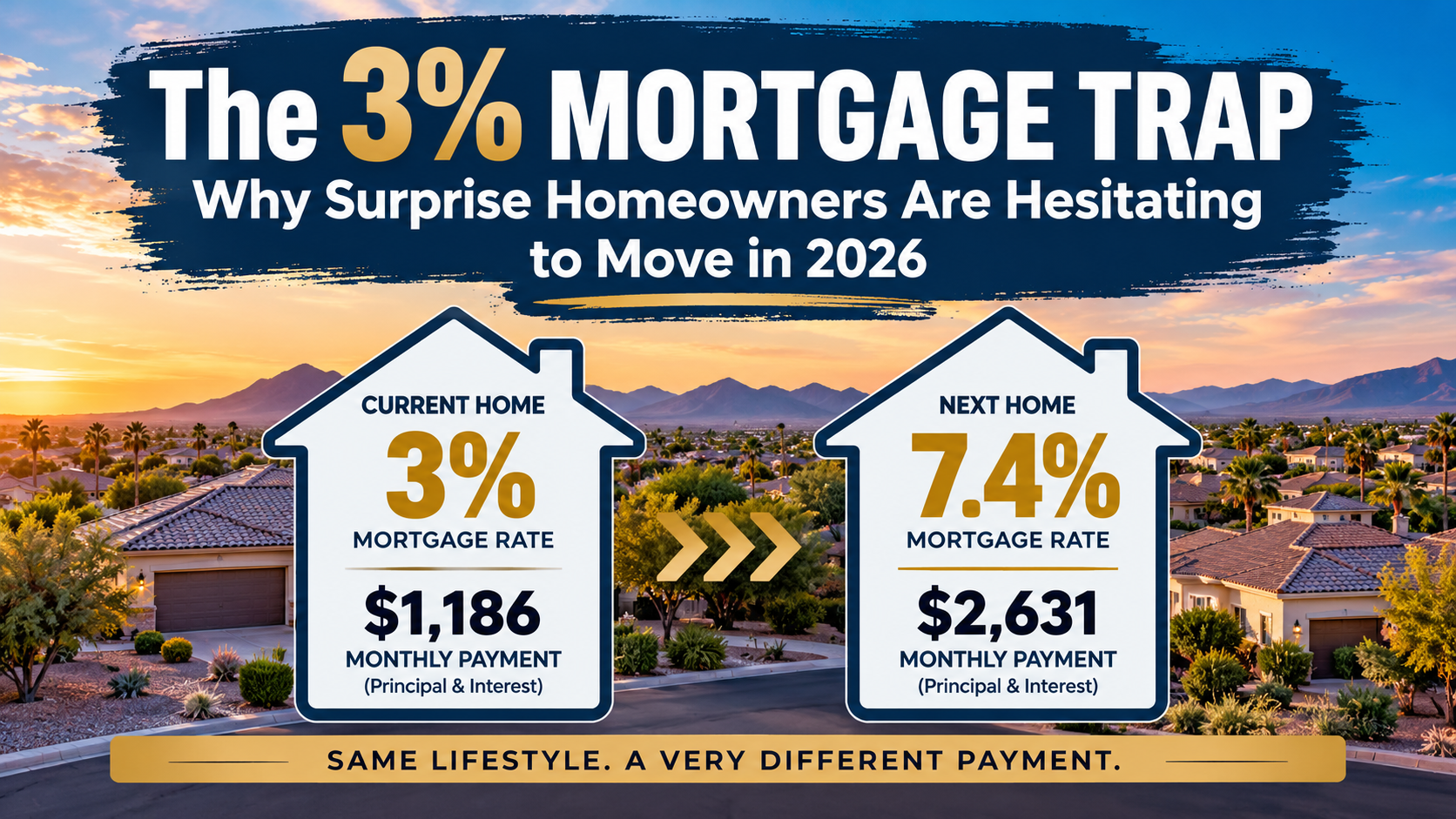
For perspective, a mortgage rate of 7.40% creates a very different payment than a 3% rate on the same loan amount. Actual rates available to buyers depend on market conditions, credit, loan terms and lender requirements.
Someone who purchased in Marley Park, Surprise Farms or another established Surprise neighborhood several years ago may have a monthly mortgage payment that would be difficult to reproduce today.
This creates what economists call the mortgage rate lock-in effect.
Homeowners aren't necessarily unwilling to sell because they dislike the available homes. They're hesitant because moving could mean giving up financing they may never be able to replace.
What Is the Mortgage Rate Lock-In Effect?
The mortgage rate lock-in effect occurs when homeowners are reluctant to sell because their existing mortgage has a significantly lower interest rate than the financing currently available.
The larger the difference between those rates, the greater the financial incentive to stay.
For some homeowners, this means delaying a move they would otherwise make.
A family might postpone purchasing a larger home. Empty nesters may remain in a house requiring more maintenance than they want. Retirees may delay moving into an active-adult community.
To understand why, let's examine the numbers.
The Real Cost of Trading a 3% Mortgage for a New Home
Let's consider a hypothetical Surprise homeowner who purchased several years ago.
Their home has appreciated, they've paid down some principal, and they're considering moving into a larger property.
Their Current Home
| Item | Amount |
|---|---|
| Estimated market value | $450,000 |
| Remaining mortgage balance | $250,000 |
| Existing fixed interest rate | 3.00% |
| Remaining mortgage term | 25 years |
| Gross home equity | $200,000 |
| Estimated selling expenses and credits | $30,000 |
| Estimated net sale proceeds | $170,000 |
Hypothetical example only. Actual sale proceeds depend on the mortgage payoff, liens, negotiated compensation, closing expenses, concessions and other obligations.
Now imagine this homeowner wants to purchase a $550,000 home and uses the estimated $170,000 in sale proceeds as a down payment.
Comparing the Mortgage Payments
| Item | Current Home | Next Home |
|---|---|---|
| Mortgage amount | $250,000 | $380,000 |
| Interest rate | 3.00% | 7.40% |
| Remaining/new term | 25 years | 30 years |
| Monthly principal & interest | $1,186 | $2,631 |
Over a year, that represents roughly $17,340 in additional principal-and-interest payments alone.
The payment increase reflects a larger loan balance ($250,000 versus $380,000), a higher interest rate and a different repayment term. It does not isolate the effect of the interest rate alone.
This comparison doesn't include property taxes, homeowners insurance, HOA dues, utilities or maintenance.
The homeowner also needs to consider purchase closing costs, moving expenses and how much cash they want to preserve.
There's another important detail: the new mortgage starts a fresh 30-year repayment schedule, while the existing loan has only 25 years remaining.
The homeowner isn't just purchasing a more expensive house. They're replacing inexpensive financing and potentially extending the period they'll carry mortgage debt.
Illustrative financing scenario using a 7.40% comparison rate, not a personalized loan quote. Payment figures are rounded. Actual rates, qualifications and terms vary.
You Have $200,000 in Equity. Why Doesn't Moving Feel Easier?
One of the most common misunderstandings in real estate is treating home equity as money that's immediately available to spend.
If your home is worth $450,000 and you owe $250,000, you have approximately $200,000 in gross equity.
But that doesn't mean you'll walk away with $200,000 when you sell.
Your proceeds may be reduced by selling expenses, concessions, mortgage payoff adjustments, outstanding liens and other costs.
Once you purchase your next home, some of those proceeds may go toward your down payment and closing expenses.
That's why I encourage homeowners to answer three questions:
- What is your home realistically worth in today's market?
- How much money would you receive after selling?
- What would your replacement home actually cost each month?
Until you know all three, you don't have enough information to decide whether moving makes sense.
Five Options Before Giving Up Your Low Mortgage Rate
The good news is that selling immediately or staying forever aren't your only choices.
1. Stay in Your Current Home and Make Improvements
Sometimes the most affordable solution is improving the home you already own.
If your primary concern is an outdated kitchen, lack of storage, landscaping or another manageable issue, renovating may cost less than replacing your mortgage.
However, renovations don't automatically add dollar-for-dollar resale value. Financing improvements through a home equity loan or HELOC also introduces another debt obligation.
The important question is whether those improvements genuinely solve your needs at a reasonable cost.
2. Consider a Smaller or Less Expensive Replacement Home
Not every move requires purchasing a more expensive property.
Some Surprise homeowners are interested in downsizing, reducing maintenance or transitioning into a different lifestyle.
For example, a homeowner selling a larger two-story property might consider a smaller single-story home.
But a lower purchase price doesn't guarantee a lower payment.
A higher mortgage rate, HOA fees, recreation fees or insurance expenses can offset the savings.
This is particularly important when comparing traditional neighborhoods with 55+ communities in Surprise and the West Valley.
The goal should be to reduce the total cost of ownership, not simply the square footage.
3. Explore New Construction and Builder Incentives
New construction homes in Surprise deserve consideration, particularly when builders offer financing incentives.
Depending on the builder, community and current promotion, incentives may include:
- Contributions toward closing costs.
- Temporary or permanent mortgage-rate buydowns.
- Discounts on selected inventory homes.
- Design-center or upgrade incentives.
However, an attractive advertised interest rate doesn't automatically mean the property is the best value.
Compare the purchase price, loan terms, incentive restrictions, HOA expenses and total payment against resale alternatives.
Builder incentives may make moving more affordable, but they should never replace a complete financial comparison.
4. Consider Keeping Your Existing Home as a Rental
Some homeowners wonder whether they should keep their low-rate mortgage, rent out their existing property and purchase another home.
In certain circumstances, this strategy may work.
But becoming a landlord introduces financial risks and responsibilities.
Consider realistic rental income, vacancies, maintenance, property management, insurance, taxes and unexpected repairs.
You also need to determine whether you qualify for the next mortgage while retaining your existing property.
Before pursuing this strategy, speak with a qualified lender and tax professional.
A low mortgage rate doesn't automatically make a property a profitable rental.
5. Move When the Lifestyle Benefits Justify the Cost
Sometimes moving isn't primarily about maximizing financial returns.
Maybe your family needs more space. Perhaps you want to live closer to your grandchildren. Maybe you're retiring, reducing your commute or looking for a single-story home that's easier to maintain.
Those are legitimate reasons to consider moving.
The key is understanding the financial trade-off before making the decision.
Should You Wait for Mortgage Rates to Drop?
This is one of the most difficult questions facing homeowners in 2026.
Waiting could make sense if you're comfortable in your current home, your mortgage is affordable and you have no immediate reason to move.
But waiting involves uncertainty.
Mortgage rates may decrease, remain elevated or increase. Home prices, available inventory and buyer competition may also change.
Even if rates fall, you could face more competition for desirable properties.
Refinancing a new mortgage might be possible later, but it's not guaranteed. Future rates, credit qualifications, home values and refinancing costs all matter.
Rather than trying to predict the perfect time to move, I recommend evaluating several scenarios:
- What happens if mortgage rates remain where they are?
- What happens if rates decline modestly?
- What happens if you find the right home today but it costs more each month?
A sound housing decision shouldn't depend on a future interest-rate prediction coming true.
What Makes This Decision Different in Surprise and the West Valley?
Surprise homeowners have several housing choices that can make this decision more complicated—and sometimes more interesting.
Established neighborhoods offer resale properties with mature landscaping, existing improvements and different price points.
Newer communities offer modern floor plans, energy-efficient features and opportunities to purchase new construction.
Active-adult communities offer another set of choices for homeowners planning retirement or a lifestyle transition.
A homeowner in Surprise Farms might be considering a newer property near Asante.
Someone in Marley Park may want a larger home with a pool or additional garage space.
A retiring homeowner might be comparing The Grand, Arizona Traditions, Sun City West or other active-adult options.
Each move involves different prices, ownership costs and lifestyle considerations.
That's why broad statements about whether it's a good time to buy or sell don't always help.
Your decision should be based on your current home, your actual mortgage, your available equity and the properties you're considering next.
When Does Selling a Home With a 3% Mortgage Make Sense?
There's no universal answer, but there are situations where selling makes sense even when the existing mortgage is exceptionally attractive.
Consider moving when:
- Your current home no longer meets your household's needs.
- You can comfortably afford the replacement property's total monthly cost.
- Your available equity puts you in a strong purchasing position.
- You're relocating for employment, family or retirement.
- The new home significantly improves your quality of life.
- You've compared realistic alternatives and understand the long-term financial consequences.
Conversely, staying may be the better choice if moving would eliminate your financial cushion, create uncomfortable monthly obligations or provide only a modest improvement in your living situation.
Before You Sell, Run the Numbers
I've been helping buyers and sellers in Surprise and the Northwest Valley since 2013, and one lesson remains consistent:
Sometimes the numbers support selling. Sometimes they support staying.
And sometimes the right approach is creating a plan today so you're prepared when circumstances change.
If you're considering giving up a low mortgage rate, start with a personalized move-up analysis.
We can review your home's estimated market value, likely selling proceeds, the competition in your neighborhood and the cost of replacement homes that meet your needs.
Then you can discuss financing scenarios with a qualified mortgage lender.
There's no reason to commit to selling before you understand your options.
Frequently Asked Questions
Is It Worth Selling My House if I Have a 3% Mortgage?
It depends on your equity, remaining mortgage balance, replacement-home costs and personal goals. A low interest rate is valuable, but it isn't the only consideration. Compare the complete financial picture before deciding.
Can I Transfer My 3% Mortgage to Another Home?
Generally, no. Most conventional mortgages cannot simply be transferred from one property to another. Some FHA and VA loans may be assumable by qualified buyers, subject to lender or servicer requirements, but an assumption does not transfer your mortgage to a different property. Learn more about VA-assumable homes in Surprise and the West Valley.
Should I Wait Until Mortgage Rates Fall Before Buying Another Home?
Waiting may be reasonable if your current home still meets your needs. However, future rates and prices are uncertain. Evaluate whether a move is affordable under today's conditions rather than relying on a future refinance.
Can I Use My Current Home Equity to Buy Another House?
Yes, potentially. Equity from a sale can help fund your next purchase. Other approaches, including a HELOC or bridge loan, may be available to qualified borrowers, but they introduce additional costs and risks. A lender can explain your options.
Is It Better to Rent Out My Current Home Instead of Selling?
It depends on rental income, expenses, financing eligibility and your willingness to manage an investment property. A low mortgage rate alone doesn't guarantee positive cash flow.
Thinking About Moving but Don't Want to Give Up Your 3% Mortgage?
Before you decide, find out what moving would actually look like financially.
Request a Personalized Surprise Move-Up Home Analysis.
- Your home's estimated market value.
- Potential net proceeds from selling.
- Available resale and new-construction alternatives.
- The practical costs and trade-offs of your next move.
No obligation to list your home.
This article is for general educational purposes and does not constitute individualized financial, tax, legal or mortgage advice. Mortgage calculations are hypothetical and subject to lender verification.
:format(webp):quality(80)/u.realgeeks.media/thepoolergroup/Facebook.jpg)
:format(webp):quality(80)/u.realgeeks.media/thepoolergroup/Instagram.jpg)
:format(webp):quality(80)/u.realgeeks.media/thepoolergroup/YouTube.jpg)